What is team composition in life
Team composition is present in every domain and stage of life. Team composition is the circle surrounding you during a specific project. I use project and team generally, whether that be a team of colleagues for a specific research paper, a group of friends for a long or short-term time period in life, teammates for a sport, partner for marriage, employees for a startup, or classmates for a school project, they all constitute a "project" and some surrounding "team".
Team composition can be both deliberately or non-deliberately chosen, where you actively choose the employees who join your startup, or the partner you choose to spend the rest of your life with, but you may not have actively chosen the friend group you had in grade school or the teammates for a club sport.
Team composition entails the skills and personality of the individuals, proactivity, ownership (feeling responsible for the project's success), communication, among other things.
I am here to state that despite not always having the opportunity to be deliberate about the team that is composed around you, it is extremely important to always take the chance to consider what team you want to be a component of, because it is the aspect that matters most in projects, more than anything else.
Why team composition is the most important aspect of a project, more than anything else
In a project, depending on the nature, there are countless other properties that dictate the success of the project. There is the actual idea or content of the project, the execution and actions taken for the project, the context surrounding the project, luck, among other factors. However, team composition is the most impactful indicator of success within a project from my experience. The individuals of a team matter more than any specific project they are working on and it's details. A project that is set up for success can fail with poor team composition and a project set to fail can thrive with the right team composition.
Here are some experiences that demonstrate this principle:
School Clubs
For the school clubs I am in, they are heavily reliant on each individual in leadership contributing their time in a proactive way such that the club itself can exist. Since the turnover is so high, there is a consistent need to teach a new generation and imbue them with institutional knowledge. The operations of a club from a member viewpoint seems quite self-explanatory and simple, but it's clear to see that in this setting if a single individual in a leadership role decides to just stop performing, then the entire club collapses, because institutional knowledge disintegrates the moment a single link in the chain stops communicating and being productive. The actual contents of the club, success in its operations, external factors and luck play very little role in the success of the club - it is purely the individuals who must keep it afloat.
Startups
For startups that are actively scaling, hiring is the biggest concern. The team that supports a startup is what can make the idea and execution work, but a good idea will just sit unbuilt if the team is poorly composed. The problem is that if the startup does not realize that hiring is a priority or just cannot make good team composition, they will fail to satisfy those already on the team, as the company may scale but the individuals only get stretched thinner.
Suite mates
Many groups of friends in college who decided to live together now actively dislike each other. This is not uncommon. In this case it's almost obvious to see how team composition is one of the only things that matters when it comes to suite mates. It does not matter the external context in which these suite mates live, but if the individuals of the living space are able to be productive in the project of harmonized living, then the project is a success. This is where it's not purely dependent on the actual skills of the individuals to clean or be respectful, but it's also how much they feel they should communicate (as it is rare that all individuals living so closely together will not disagree) as a result of how much responsibility they feel for making the project of living together a success.
A proposed view
In a specific view, there is a way to envision how productivity/success/happiness or any other metric increases or decreases as a function of the team members and their skills/productivity/personality and communication.
In the following formula, it's specifically denoting total productivity as a function of the productivity of the individual, total number of individuals and average communication between members. However, this can generalize where productivity can be the skills for the project, agreeability, emotional intelligence, or other.
Where , , , and
By this formula, it's easier to understand by the individual terms and specific cases.
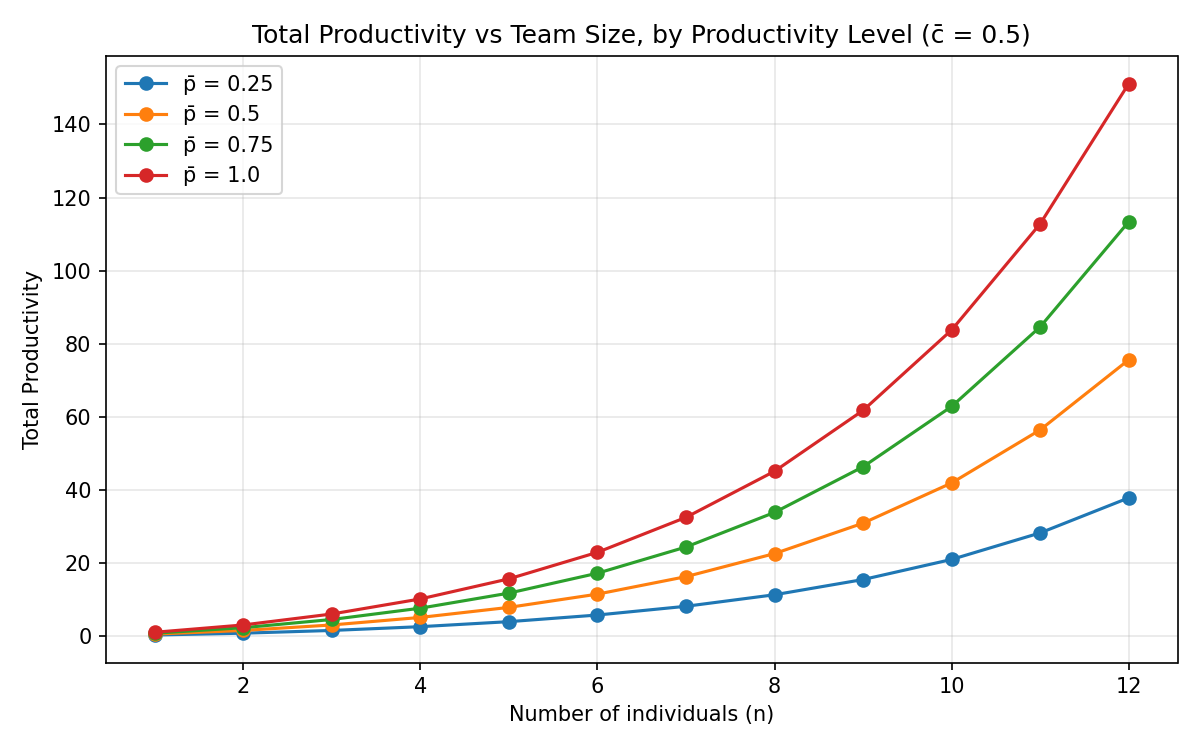
The sum states that the total productivity is a multiple of the sum of the individuals' productivity. Where if you are an individual with a productivity of 1, then adding an individual with a productivity of 0 will not change the total success, but any other marginal amount of productivity is effectively an addition to the result which will become the multiplier.
The expression within the square brackets can be understood through a couple of specific cases:
- First, if there is only one individual, then the expression becomes , and thus the total productivity is independent of the communication, because there is only one person on the team
- If communication is neutral at 0, then the expression within the square brackets just becomes , meaning the total productivity is just the sum of the productivity of each individual. This is equivalent to how a task can be split into multiple parts and each individual can work on each part individually, adding their productivity to the team.
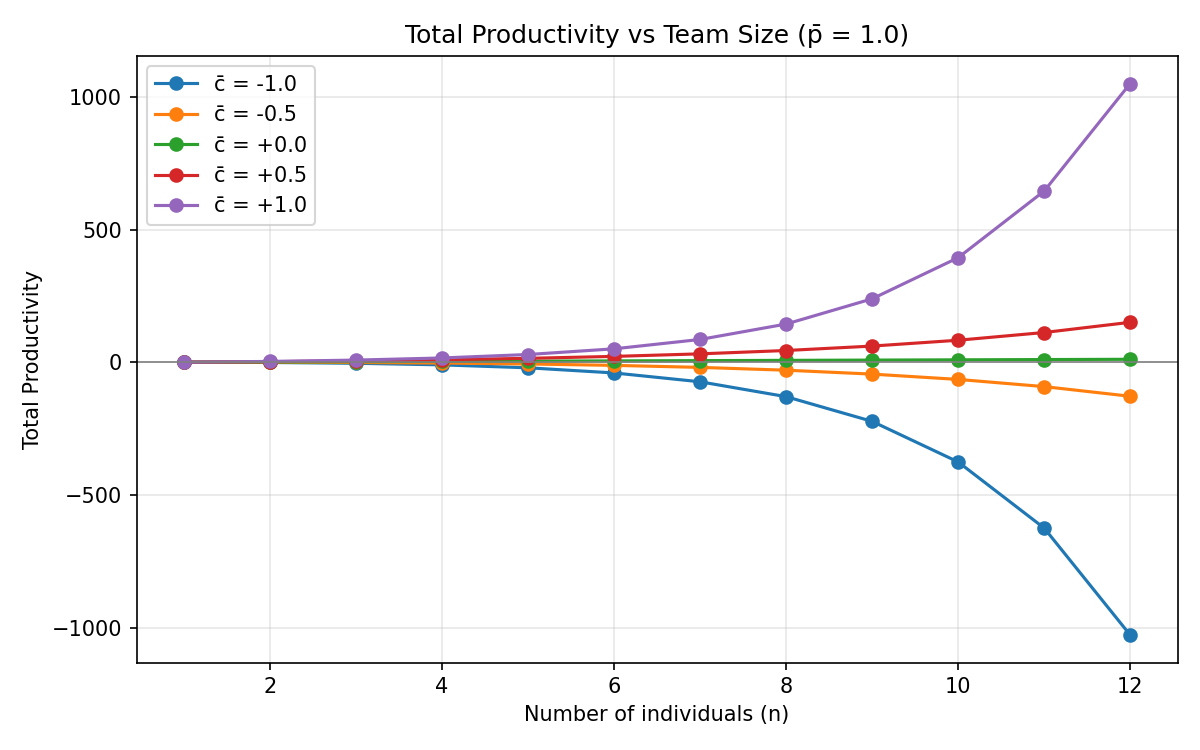
- If communication is positive at 0.5, then the resulting expression is a small positive value, which is multiplied by the sum of the individuals' productivity. This effectively states that if there exists non-neutral communication, then the team is more than the sum of their productivity, as they can do more than work in parallel, but become more efficient through collaboration.
- If communication is negative at -0.5, the opposite effect occurs and demonstrates how additional individuals with poor communication can ultimately drive down a team's productivity despite each individual being more productive. There could be unresolved disagreements, stepping on toes, and more.
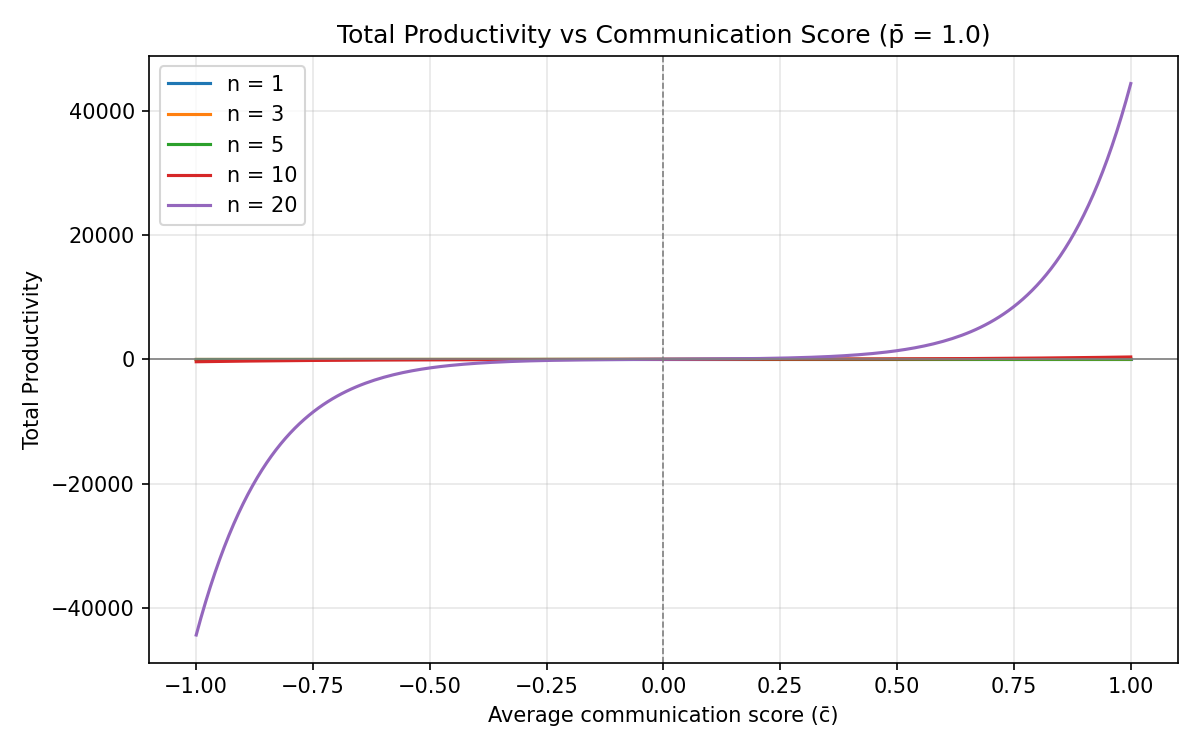
- If communication is positive at 1, we effectively get a stronger effect on productivity than 0.5. If communication is negative at -1, it's also the effect in the opposite direction.
Here are some graphs to visualize the effect of team composition as I believe it to be:
Two big things
Focusing on team composition is not just to optimize for productivity, but happiness, experiences, goals, and more.
The most important aspect to be mindful of is that this idea is not to push one to orchestrate the team they are surrounded by, but to instead be the type of teammate that others want to be surrounded by.